
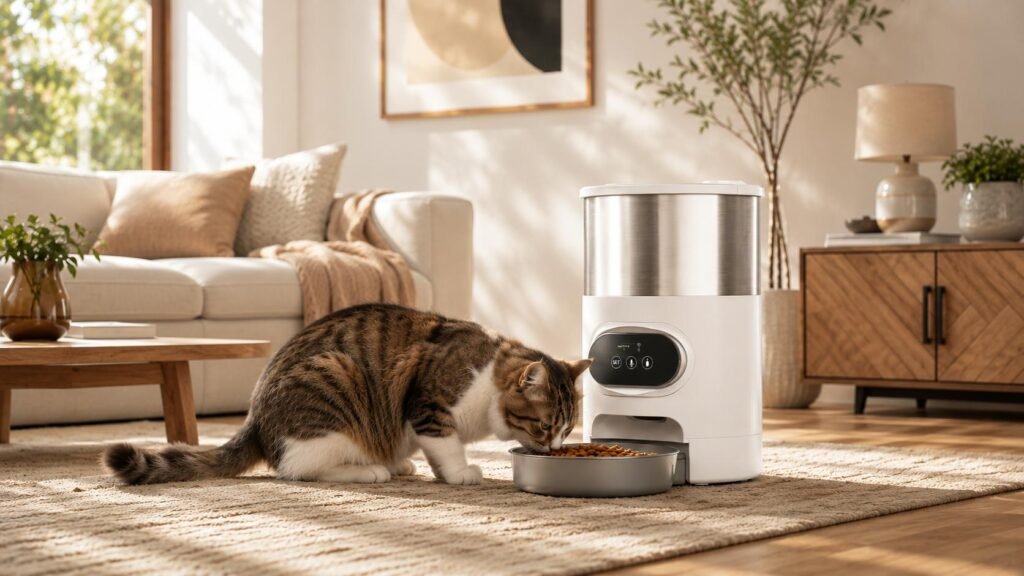
Automatic Pet Feeders: Benefits, Drawbacks & Buying Guide
Discover the benefits and drawbacks of automatic pet feeders, how they work, important features and how to choose the right feeder for your pet.
Looking after our pets means making sure they receive the right food, in appropriate portions and at regular times. However, maintaining a consistent feeding routine can sometimes be challenging, especially when work, travel and other daily responsibilities keep us busy.
This is where automatic pet feeders can make a difference.
Automatic pet feeders are becoming increasingly popular among cat and dog owners because they can dispense scheduled meals without requiring someone to fill the bowl at every feeding time. Some advanced models even offer smartphone control, portion settings, feeding notifications and camera features.
But are automatic pet feeders really worth buying? Can they help maintain a healthy feeding routine? What are their limitations, and how do you choose the right model?
In this guide, we’ll explore the benefits and drawbacks of automatic pet feeders, explain how they work and highlight the important features to consider before making a purchase.
1. What Is an Automatic Pet Feeder?
An automatic pet feeder is a device designed to dispense a predetermined quantity of pet food at scheduled times.
Unlike a traditional food bowl, which needs to be filled manually, an automatic feeder can release food according to a programmed feeding schedule.
Most models are designed for dry pet food, although some specialised products can accommodate wet food.
Depending on the model, an automatic pet feeder may include:
-
- A food storage container or hopper
-
- A dispensing mechanism
-
- A programmable timer
-
- Portion-control settings
-
- A food bowl or feeding tray
-
- A power supply
-
- Optional battery backup
-
- Wi-Fi or smartphone connectivity on selected models
The main purpose is to make feeding more convenient and help establish a consistent routine.
However, automatic feeders are not all the same. Capacity, portion accuracy, food compatibility, and features can vary considerably.
2. How Does an Automatic Pet Feeder Work?
Most automatic pet feeders operate through a relatively simple mechanism.
The owner fills the food container, sets the feeding times and selects the desired portion size. At the programmed time, the feeder activates its dispensing mechanism and releases food into the bowl.
Here is how the process generally works.
Step 1: Fill the Food Container
The owner places suitable pet food into the storage hopper. Many models are designed for dry kibble.
Step 2: Set the Feeding Schedule
Using the feeder’s control panel or smartphone application, the owner selects the meal times.
Some models allow several meals to be programmed throughout the day.
Step 3: Select the Portion Size
Depending on the device, the owner can choose the number of dispensing portions or adjust the serving quantity.
A feeder’s portion setting does not automatically guarantee an accurate weight in grams. Different kibble sizes and shapes can affect how much food is dispensed.
Step 4: Automatic Food Dispensing
At the selected time, the motor or dispensing mechanism releases food into the feeding bowl.
Step 5: Monitor the Feeding Routine
Some advanced feeders send notifications or allow owners to check feeding activity through a smartphone application.
These features depend on the specific model and its connectivity.
3. Main Benefits of Automatic Pet Feeders

Automatic pet feeders offer several advantages for busy pet owners. Their usefulness depends on the pet’s needs, the quality of the device and how carefully it is configured.
Benefit 1: Consistent Feeding Times
One of the main advantages is the ability to establish a regular feeding schedule.
Pets often benefit from predictable daily routines. An automatic feeder can dispense meals at the same programmed times, even when the owner is occupied with other responsibilities.
Benefit 2: Convenient for Busy Owners
Work commitments, household responsibilities and unexpected delays can sometimes make regular feeding difficult.
An automatic feeder can help maintain scheduled meals when the owner is temporarily unavailable.
However, it should not be considered a replacement for someone checking on the pet and ensuring that it is healthy and comfortable.
Benefit 3: Helps Manage Meal Portions
Many automatic feeders allow owners to select dispensing portions.
This can help organise daily food distribution and reduce the temptation to pour an unnecessarily large serving into the bowl.
For pets that need controlled food portions, the feeder can be a useful tool when configured according to veterinary feeding advice.
Nevertheless, portion settings should be checked against the actual amount dispensed.
Benefit 4: Useful for Multiple Meals Throughout the Day
Some pets are fed several smaller meals rather than one or two larger meals.
An automatic feeder can help distribute meals throughout the day, depending on the number of schedules supported by the device.
Benefit 5: Useful During Short Periods Away from Home
A programmable feeder can provide scheduled dry-food meals when the owner is away for a limited period.
However, pets still need fresh water, appropriate supervision and attention to their general wellbeing.
An automatic feeder does not make it safe to leave a pet unattended for extended periods.
Benefit 6: Smart Features and Remote Control
Some modern feeders connect to a home Wi-Fi network and offer smartphone applications.
Depending on the product, features may include:
-
- Remote feeding commands
-
- Feeding schedules
-
- Low-food notifications
-
- Feeding history
-
- Camera monitoring
-
- Voice recording or mealtime alerts
These features can make feeding management more convenient, but they are not essential for every household.
4. Possible Drawbacks of Automatic Pet Feeders
Although automatic feeders can be helpful, they also have limitations that owners should understand before buying one.
Drawback 1: Initial Purchase Cost
A traditional food bowl is inexpensive, whereas an automatic feeder requires a greater initial investment.
Smart feeders with cameras, Wi-Fi and additional features may cost considerably more than basic programmable models.
Drawback 2: Mechanical Problems
Automatic feeders contain moving parts, motors and electronic components.
Food can occasionally become stuck, dispensing mechanisms may wear out, and electronic systems can malfunction.
Regular inspection and maintenance are important.
Drawback 3: Dependence on Electricity or Batteries
Some feeders rely on a mains power supply, while others use batteries or offer both options.
A power interruption may affect feeding schedules unless the model has suitable battery backup.
Owners should understand what happens during a power failure and check the battery condition regularly.
Drawback 4: Food Compatibility
Many automatic feeders are designed specifically for dry kibble.
Food that is too large, irregularly shaped or unsuitable for the dispensing mechanism may cause blockages.
Always check the manufacturer’s recommended kibble dimensions and food compatibility.
Drawback 5: Portion Accuracy Can Vary
A programmed dispensing portion does not always correspond to an exact weight.
The amount released may vary depending on kibble size, shape and the feeder’s mechanism.
For pets that require carefully controlled diets, measure the actual dispensed amount and check it periodically.
Drawback 6: Not Every Pet Accepts Them Immediately
Some pets may be frightened by the sound of a motor or the movement of the dispensing mechanism.
Others may try to knock over the feeder or access the food container.
Introduce the appliance gradually and supervise your pet while it becomes familiar with the device.
Drawback 7: Cleaning Is Still Necessary
Food residue, crumbs and oils can accumulate in the hopper, dispensing mechanism and bowl.
The feeder should be cleaned according to the manufacturer’s instructions.
A machine that dispenses food automatically does not clean itself.
5. Different Types of Automatic Pet Feeders

Automatic feeders are available in several designs. Understanding the differences will help you select the right product.
1. Programmable Automatic Feeders
These are basic models that allow owners to set specific feeding times and portions.
They are generally suitable for people who want straightforward automated feeding without complicated smart features.
2. Wi-Fi and Smart Automatic Feeders
Smart feeders connect to a home network and can be controlled through a smartphone application.
Depending on the model, owners may be able to change feeding schedules, dispense additional portions and receive notifications.
Some also include cameras and microphones.
3. Gravity Pet Feeders
Gravity feeders use gravity to replenish the food bowl as food is consumed.
They are simple and do not usually require electronic programming.
However, they generally do not provide precise meal scheduling or portion control. They may also allow pets to eat more than intended.
4. Portion-Control Automatic Feeders
These feeders are designed to release selected portions at scheduled times.
They may be particularly useful when owners want to organise a pet’s daily food allowance into several meals.
The actual portion size should always be checked rather than relying solely on the displayed setting.
5. Wet Food Automatic Feeders
Some specialised feeders are designed for wet food.
Depending on the model, they may use covered compartments, timed lids or cooling systems to manage food freshness.
Wet food requires particular attention to storage temperature and food safety. Follow the manufacturer’s instructions and your veterinarian’s feeding guidance.
6. Automatic Pet Feeders for Cats vs. Dogs
Cats and dogs have different feeding habits, body sizes and dietary requirements. Choosing a suitable feeder means considering these differences.
Automatic Feeders for Cats
Cats may benefit from several smaller meals distributed throughout the day.
When selecting a cat feeder, consider:
-
- Suitable portion settings
-
- A feeding schedule that matches your cat’s routine
-
- A hopper that accommodates the recommended food
-
- A secure lid that prevents food access
-
- Easy cleaning
-
- A quiet dispensing mechanism
For households with multiple cats, individual feeding access can be particularly important.
A standard feeder may not prevent one cat from eating another cat’s food. Microchip-controlled feeders may be worth considering when individual access is necessary.
Automatic Feeders for Dogs
Dogs vary considerably in size and appetite.
A feeder suitable for a small dog may not provide enough food capacity or dispensing volume for a large breed.
Dog owners should consider:
-
- Food hopper capacity
-
- Kibble size compatibility
-
- Portion range
-
- Bowl height and accessibility
-
- Stability
-
- Resistance to accidental opening or food theft
For larger or particularly enthusiastic dogs, a sturdy design with secure food storage may be especially important.
7. Important Features to Consider Before Buying

Before purchasing an automatic pet feeder, it is worth comparing more than just the price.
Here are the main features to examine.
1. Food Storage Capacity
Choose a hopper that accommodates your pet’s food requirements without being unnecessarily large.
Remember that stored food should remain fresh and be kept according to the manufacturer’s recommendations.
2. Feeding Schedule
Check how many meals can be programmed each day.
Some devices support only a few meals, while others offer more flexible scheduling.
3. Portion Control
Look for clear information about dispensing increments and portion accuracy.
If your pet requires a precise food allowance, test the feeder and measure its output.
4. Power Supply and Battery Backup
Check whether the feeder uses mains electricity, batteries or both.
Battery backup can be useful during power interruptions, but it is important to understand whether it maintains the programmed schedule.
5. Food Compatibility
Check the manufacturer’s recommended food type and kibble size.
Do not assume that every automatic feeder can dispense all types of dry food.
6. Cleaning and Maintenance
Choose a design with removable food-contact components and straightforward cleaning instructions.
Avoid models that make it difficult to reach areas where crumbs and residue may accumulate.
7. Smart Connectivity
If you prefer remote control, check the Wi-Fi requirements, smartphone compatibility and whether a subscription is needed for additional features.
8. Security and Durability
Look for a stable feeder with a secure lid and a reliable dispensing mechanism.
This is especially important if your pet is curious or tends to investigate food containers.
9. Availability of Replacement Parts
Check whether replacement bowls, motors, batteries and other components are available.
Good after-sales support can make a significant difference to the long-term value of the feeder.
8. Automatic Pet Feeder vs. Traditional Food Bowl

Is an automatic feeder always better than a traditional bowl?
Not necessarily. Both can be useful, depending on your pet’s feeding requirements and your household routine.
| Feature | Automatic pet feeder | Traditional food bowl |
|---|---|---|
| Scheduled meals | Yes, on programmable models | Manual |
| Portion settings | Available on selected models | Manual measurement |
| Initial cost | Higher | Lower |
| Electricity or batteries | Usually required | Not required |
| Remote control | Available on smart models | Not available |
| Maintenance | Cleaning and mechanical checks | Regular washing |
| Flexibility | Depends on programming | Fully manual |
| Human supervision | Still necessary | Still necessary |
A traditional bowl may be perfectly adequate for pets whose owners can maintain a consistent feeding schedule.
An automatic feeder is more useful when scheduled dispensing and portion organisation provide genuine convenience.
9. Cleaning and Maintaining an Automatic Pet Feeder
Regular cleaning is essential to keep an automatic feeder working properly and maintain good food hygiene.
Follow these simple maintenance practices:
-
- Empty and clean the food bowl regularly.
-
- Remove crumbs and food residue from the dispensing area.
-
- Wash removable components according to the manufacturer’s instructions.
-
- Keep electrical components and motors away from water.
-
- Check the dispensing mechanism for blockages.
-
- Inspect the food container and lid.
-
- Replace batteries when required.
-
- Check that programmed feeding times remain correct.
Never immerse electronic components in water unless the manufacturer specifically states that they are suitable for washing.
For wet-food feeders, pay particular attention to food storage temperature, cleaning frequency and the manufacturer’s safety guidance.
10. Important Feeding and Safety Considerations
Automatic feeders can help organise meals, but they should be used responsibly.
Here are some important points:
Do not rely entirely on the machine. Check regularly that food is being dispensed correctly and that your pet is eating.
Follow appropriate feeding quantities. The correct daily food allowance depends on your pet’s age, weight, activity, health and diet.
Monitor your pet’s weight. Automated feeding does not automatically prevent overeating or obesity.
Keep fresh water available. Food automation does not replace the need for constant access to suitable drinking water.
Have a backup feeding arrangement. Keep a plan for power failures, mechanical faults or unexpected schedule changes.
Do not leave pets unattended for extended periods. Automatic feeders cannot provide companionship, exercise, toileting opportunities or emergency care.
If your pet has a medical condition, special dietary requirements or needs medication with meals, consult your veterinarian before changing its feeding arrangements.
11. Frequently Asked Questions
Are automatic pet feeders worth buying?
They can be worthwhile for owners who want scheduled feeding, portion organisation and additional convenience. However, they are not essential for every pet, and their value depends on the animal’s needs and the owner’s routine.
Can automatic feeders help prevent overeating?
Some portion-control models can help organise meal quantities. However, they do not guarantee healthy weight management. Owners should set appropriate portions and monitor their pet’s weight.
Are automatic pet feeders suitable for both cats and dogs?
Yes. There are models designed for both cats and dogs. Choose one that suits the animal’s size, food type, eating habits and daily food requirements.
Can automatic pet feeders dispense wet food?
Some specialised feeders can dispense wet food. Many standard models are designed for dry kibble only. Always check food compatibility and follow food-safety instructions.
What happens if the electricity goes off?
The result depends on the feeder. Some models include battery backup, while others may stop operating. Check the manufacturer’s specifications and keep a backup feeding arrangement.
How often should an automatic pet feeder be cleaned?
Cleaning frequency depends on the design, food type and manufacturer’s instructions. Food bowls and food-contact surfaces should be cleaned regularly, and the dispensing mechanism should be checked for residue and blockages.
Can I leave my pet alone with an automatic feeder?
An automatic feeder can help dispense scheduled meals, but it cannot replace proper supervision and care. Pets still need fresh water, attention, exercise and someone who can respond if something goes wrong.
Are smart Wi-Fi pet feeders better than basic models?
Not necessarily. Smart feeders offer remote control and additional features, but a basic programmable feeder may be sufficient for many households. Choose based on the features you genuinely need.
12. Final Verdict: Are Automatic Pet Feeders Really Worth It?
Automatic Pet Feeders: Benefits, Drawbacks & Buying Guide. Automatic pet feeders can be valuable tools for modern pet owners.
They offer scheduled meal dispensing, portion organisation and convenience, particularly for households with busy daily routines. Some advanced models also provide remote control and feeding notifications.
However, they have limitations. They require an initial investment, regular cleaning, occasional maintenance and a reliable power arrangement. They can also malfunction or dispense the wrong portion if set up incorrectly.
Our recommendation: Consider an automatic pet feeder if you want a more organised feeding routine and can monitor and maintain the appliance properly.
For most owners, a reliable programmable feeder with suitable food capacity, dependable dispensing, easy cleaning and battery backup is a sensible starting point.
Smart features such as cameras and Wi-Fi can be useful extras, but they shouldn’t distract from the most important considerations: accurate feeding, food safety, and your pet’s wellbeing.
Ultimately, technology should make responsible pet care easier, not replace the attention and affection our animals need.
Disclaimer: This article is for general informational purposes only and is not a substitute for veterinary advice. Consult a qualified veterinarian about appropriate food quantities, feeding schedules and special dietary requirements for your pet.