
3 Best Microchip Cat Feeders for Prescription Diets: 2026 Guide
Best Microchip Cat Feeders for Prescription Diets in 2026: Compare SureFeed, Connect, and PETLIBRO RFID options for selective feeding, wet food, and dry food.
Introduction
Feeding cats with different dietary requirements can be challenging, particularly when one cat needs prescription food, and another is perfectly happy eating a regular diet. You may carefully measure each meal, supervise feeding time, and place bowls in separate rooms, only to discover that one cat has finished its own dinner and moved on to someone else’s.
This is where the best microchip cat feeders for prescription diets can make a meaningful difference. Instead of simply dispensing food at a particular time, selective-access feeders recognise an authorised pet and help restrict access to its meal.
For households where one cat needs a veterinarian-prescribed diet, that extra layer of control can be useful. It may also help owners manage food stealing, portion access, and feeding routines when several cats share the same home.
However, not every selective feeder reads an implanted microchip. Some models use a dedicated RFID collar tag, and others offer connected monitoring or scheduled dispensing rather than the same access-control system. Wet-food compatibility also matters, especially when a cat’s prescribed diet includes canned food.
In this guide, we’ll compare three relevant options, explain their differences, and help you determine which type best fits your household. We’ll also cover practical limitations, cleaning, portion control, and what to check before buying.
Table of Contents
-
- Quick Comparison
-
- Why Prescription Diets May Need Selective Feeding
-
- What Is a Microchip Cat Feeder?
-
- 1. SureFeed Microchip Pet Feeder
-
- 2. SureFeed Microchip Pet Feeder Connect
-
- 3. PETLIBRO One RFID Smart Feeder
-
- How to Choose a Feeder for Prescription Diets
-
- Microchip Feeder vs Standard Automatic Feeder
-
- Pros and Cons
-
- Frequently Asked Questions
-
- Final Verdict
Quick Comparison
The three options below use different approaches to selective feeding. The first two recognise an implanted pet microchip or compatible RFID collar tag, while PETLIBRO uses its own dedicated RFID collar tag rather than an implanted microchip.
| Feature | SureFeed Microchip Pet Feeder | SureFeed Connect | PETLIBRO One RFID |
|---|---|---|---|
| Implanted microchip recognition | Yes | Yes | No |
| Dedicated RFID collar tag | Yes | Yes | Yes, required |
| Wet food | Yes | Yes | No |
| Dry food | Yes | Yes | Yes |
| Selective access | Yes | Yes | Yes |
| App monitoring | No connected monitoring | Yes, with Hub | Yes |
| Automated timed dispensing | No | No | Yes |
| Best suited to | Simple selective feeding | Selective feeding and monitoring | Scheduled dry-food feeding with RFID access |
Sources: official SureFeed Microchip Pet Feeder, SureFeed Connect, and PETLIBRO One RFID product information.
surepetcare.com
Important: These products, Best Microchip Cat Feeders for Prescription Diets, aren’t completely interchangeable. If your cat eats wet prescription food, PETLIBRO One RFID isn’t suitable because its manufacturer specifies dry food only.
PETLIBRO
Why Prescription Diets May Need Selective Feeding
Prescription diets are often part of a veterinarian’s plan for managing a particular health condition or nutritional requirement. In multi-cat households, the challenge isn’t always getting a cat to eat its own food. Sometimes, it’s preventing another cat from eating it.
Consider a few common household situations:
-
- One cat eats a veterinarian-recommended renal diet while another eats standard adult food.
-
- One cat requires measured portions, while another has different calorie requirements.
-
- A cat needs a specific gastrointestinal diet, but its housemate prefers the taste.
-
- One cat eats slowly, leaving its bowl unattended long enough for another cat to investigate.
A standard automatic feeder can help with meal timing, but it generally cannot identify which cat is eating from the bowl. A selective-access feeder addresses that specific problem by recognising an authorised pet.
It’s worth remembering that a feeder is a feeding-management tool, not a medical treatment. Follow your veterinarian’s instructions about the prescribed food, portions, and schedule.
What Is a Microchip Cat Feeder?
A microchip cat feeder uses identification technology to help control access to food.
Implanted microchip recognition
The feeder recognises a compatible identification microchip implanted beneath the cat’s skin. Once the cat is registered, the feeder can open for that animal while remaining closed to unauthorised pets.
RFID collar-tag recognition
Some feeders use a dedicated RFID tag attached to a collar. The reader recognises the tag and grants access to the food.
Although both systems use radio-frequency identification technology, a dedicated RFID collar tag is not the same as an implanted microchip. Compatibility depends on the specific feeder.
For example, the SureFeed Microchip Pet Feeder supports compatible implanted microchips and SureFlap RFID collar tags. PETLIBRO One RFID recognises its own dedicated collar tag and does not currently read implanted pet microchips.
surepetcare.com
This difference should be one of your first considerations when shopping.
1. SureFeed Microchip Pet Feeder
SureFeed Microchip Pet Feeder
For selective feeding
Best suited to households needing straightforward access control.
Official product:
SureFeed Microchip Pet Feeder
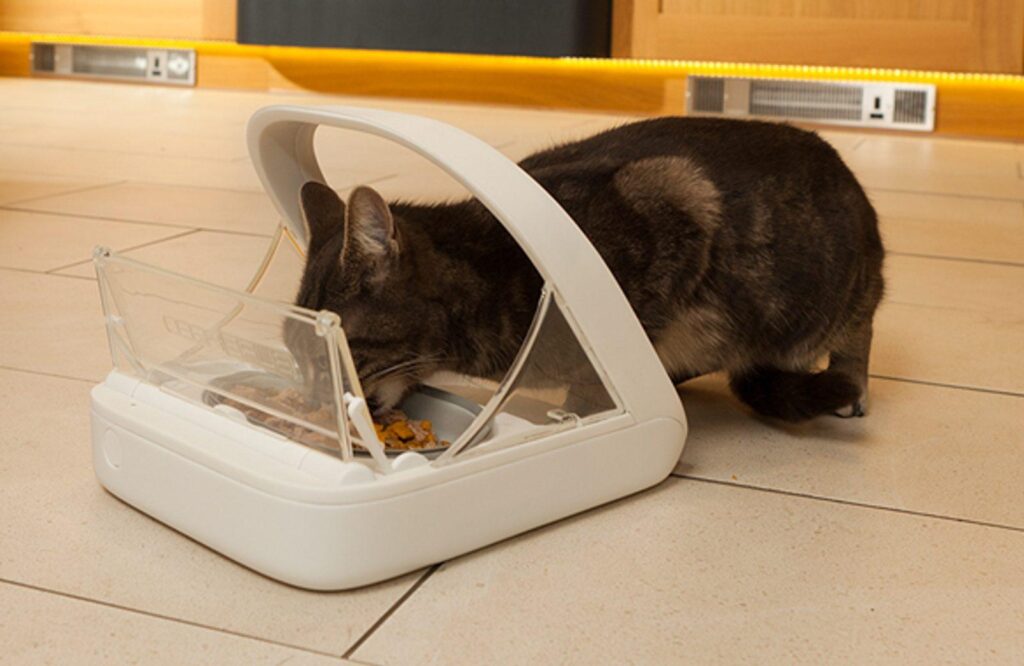
The SureFeed Microchip Pet Feeder is designed to help prevent one pet from eating another pet’s food. It recognises an authorised microchip or compatible RFID collar tag and opens the bowl for the registered animal.
Its ability to accommodate both wet and dry food makes it particularly relevant to households where prescription food comes in different forms. The manufacturer lists a 400 ml bowl capacity, with space for approximately two pouches of wet food.
surepetcare.com
Key features
-
- Recognition of compatible implanted microchips
-
- Support for a compatible RFID collar tag
-
- Wet- and dry-food compatibility
-
- Covered bowl that helps keep food fresher
-
- Selective access for multi-pet homes
-
- Training mode to help pets get used to the moving lid
Why it may suit prescription diets
The main advantage is its focus on who can access the food, rather than on dispensing meals at predetermined times.
Suppose your cat needs a prescribed wet food while another cat eats a different diet. You can register the intended cat, serve the appropriate food, and allow the feeder to manage access while the cat eats.
This can be particularly useful for slow eaters, provided the feeder is positioned sensibly, and the other cat cannot exploit an unusual approach angle.
Limitations
The standard model isn’t a Wi-Fi-controlled timed feeder. You still need to prepare and refill meals yourself, and you should supervise the initial training period.
A determined food thief may also require additional measures, such as the manufacturer’s rear cover accessory or feeding in a separate room.
Best suited for: Cat owners who want selective access for wet or dry food without needing connected feeding reports.
2. SureFeed Microchip Pet Feeder Connect

SureFeed Microchip Pet Feeder Connect
Connected monitoring
Best suited to owners who want feeding information as well as selective access.
Official product:
SureFeed Connect
The SureFeed Connect builds on the selective-access approach by adding connected feeding monitoring. It is designed for owners who want more information about their pet’s eating habits, not just a way to stop food stealing.
The manufacturer describes features that include app-based feeding information, integrated scales, portion-weight guidance, and access restricted to a registered pet’s microchip or compatible RFID collar tag. It supports wet and dry food.
surepetcare.com
Key features
-
- Microchip or compatible RFID collar-tag access
-
- Wet- and dry-food compatibility
-
- App-based feeding information
-
- Integrated scales and portion-weight guidance
-
- Feeding frequency and duration information
-
- Requires the Sure Petcare Hub for app connectivity
Why it may suit prescription diets
When a cat has a prescribed diet, consistency can matter. Connected feeding information may help owners see whether a cat visits its feeder regularly and spot changes worth discussing with a veterinarian.
The integrated scales also help when you need to measure food portions. Best Microchip Cat Feeders for Prescription Diets is useful for owners who want a more structured record of how much food is offered or consumed.
However, feeding data isn’t a diagnosis. A change in eating behaviour can have many causes, so use the information as a practical observation rather than a substitute for veterinary advice.
Limitations
The Connect model requires a compatible Hub to connect to the app. If you don’t already own a connected Sure Petcare product, factor the Hub into the total cost.
surepetcare.com
It also remains a selective-access bowl rather than a conventional hopper-based automatic feeder. You’ll still need to supply the food.
Best Microchip Cat Feeders for Prescription Diets suited for: Owners who want selective access plus connected feeding records and portion-weight guidance.
3. PETLIBRO One RFID Smart Feeder

PETLIBRO One RFID Smart Feeder
RFID collar tag required
Best Microchip Cat Feeders for Prescription Diets suited to scheduled dry-food feeding with personalised access.
Official product:
PETLIBRO One RFID Smart Feeder
PETLIBRO One RFID takes a different approach. Instead of reading an implanted microchip, it recognises a dedicated RFID collar tag associated with the feeder.
The current manufacturer specifications list a 3-litre food tank, Wi-Fi connectivity, scheduled feeding, a stainless-steel bowl, and compatibility with dry kibble approximately 2–15 mm in size. The feeder can be linked to only one collar tag.
PETLIBRO
Key features
-
- Dedicated RFID collar-tag recognition
-
- Scheduled dry-food dispensing
-
- App control and feeding information
-
- 3-litre food tank
-
- Stainless-steel bowl
-
- Backup battery support
-
- Compatible kibble size of approximately 2–15 mm
Why it may suit some special diets
If your cat eats dry prescription food and you want both scheduled dispensing and personalised access, PETLIBRO One RFID may be worth considering.
Its hopper-based design differs from the SureFeed bowls because it can dispense scheduled portions. That can be useful for owners who want to automate a dry-food routine while limiting access to the cat wearing the paired tag.
Important limitations
There are three major things to understand before buying:
-
- It does not recognise implanted microchips. The dedicated RFID collar tag is required.
-
- It is for dry food only. It isn’t appropriate for wet prescription diets.
-
- Each feeder pairs with one collar tag. A separate feeder and tag setup may be needed for another pet.
 petlibro.com
- Each feeder pairs with one collar tag. A separate feeder and tag setup may be needed for another pet.
Because the tag is worn on a collar, consider whether your cat comfortably and reliably wears one.
Best Microchip Cat Feeders for Prescription Diets suited for: Owners who feed dry kibble, want scheduled dispensing, and are comfortable using a dedicated RFID collar tag.
How to Choose a Feeder for Prescription Diets
Before buying, focus on the practical needs of your cat rather than the number of smart features advertised.
1. Confirm the identification system
If your cat already has an implanted microchip and you don’t want to rely on a collar tag, choose a feeder that explicitly supports compatible implanted chips.
Don’t assume that every product described as an RFID feeder will recognise an implanted microchip.
2. Check wet-food compatibility
Best Microchip Cat Feeders for Prescription Diets are not all dry kibble. If your cat eats wet food, confirm that the bowl and lid system are designed for it.
The SureFeed models support wet and dry food, while PETLIBRO One RFID is specified for dry food only.
surepetcare.com
3. Decide whether you need scheduling or access control
These are separate functions.
-
- Access control helps determine which pet can eat.
-
- Scheduled dispensing helps determine when and how much food is dispensed.
-
- Connected monitoring provides information about feeding behaviour.
One product may offer some of these features without offering all of them.
4. Consider portion measurement
If your veterinarian has recommended a specific daily amount, ask how the feeder measures portions and whether you need to weigh the food separately.
The SureFeed Connect provides integrated scales and portion-weight guidance. Other models may use different dispensing methods.
5. Think about food stealing and feeder placement
A selective feeder is designed to restrict unauthorised access, but household layout still matters.
Consider whether another cat can approach from behind, push the authorised cat aside, or interfere with the lid. Accessories such as a rear cover may help in some situations.
6. Consider your cat’s temperament
Some cats adapt to a moving lid quickly; others need gradual training. Allow time for your cat to become comfortable with the feeder before relying on it for every meal.
7. Check cleaning requirements
Best Microchip Cat Feeders for Prescription Diets routines can be demanding enough without difficult cleaning. Look for removable bowls, accessible food-contact surfaces, and clear cleaning instructions.
Microchip Feeder vs Standard Automatic Feeder
The difference is important when you’re choosing a product for a multi-cat home.
| Feature | Standard automatic feeder | Selective-access feeder |
|---|---|---|
| Schedules meals | Usually | Model-dependent |
| Dispenses measured portions | Usually, but varies | Model-dependent |
| Identifies a particular pet | Usually no | Yes |
| Helps prevent food stealing | Limited | Designed for selective access |
| Suitable for wet food | Model-dependent | Model-dependent |
| Can support separate diets | Only with careful management | Can help restrict access |
| Connected feeding records | Model-dependent | Available on connected models |
A conventional automatic feeder, such as the standard Petlibro Granary, can automate a feeding schedule. But it isn’t designed to identify which cat is eating from its bowl.
If you’re deciding whether you need scheduling or individual-pet access, see our Petlibro Granary Review and Petlibro Granary vs SureFeed Microchip comparison.
These articles cover complementary approaches to automated pet feeding.
Pros and Cons
Benefits of selective-access feeders
-
- Help restrict food access to the intended cat
-
- Useful in multi-cat homes with different diets
-
- Some models support both wet and dry food
-
- Can reduce opportunities for food stealing
-
- Connected versions may provide useful feeding information
-
- Some models work with an existing implanted microchip
Limitations to consider
-
- Selective access doesn’t guarantee that every meal is eaten
-
- Some feeders require a dedicated collar tag
-
- Connected models may require an additional Hub
-
- Wet-food and dry-food compatibility varies
-
- Cats may need time to adjust to a moving lid
-
- The owner still needs to prepare suitable food and follow veterinary instructions
-
- Persistent food stealing may require changes to feeder placement or household feeding routines
Frequently Asked Questions
1. What is the best type of feeder for a cat on a prescription diet?
It depends on the food and the problem you’re trying to solve. A microchip feeder may help restrict access to the intended cat’s food. If you also need scheduled dry-food dispensing, an RFID-based hopper feeder may be appropriate, provided your cat can wear its dedicated tag.
2. Do microchip feeders prevent other cats from eating prescription food?
They’re designed to restrict access to a registered pet, which can reduce food stealing. However, the result depends on the feeder’s design, the cat’s behaviour, and how the feeder is positioned. Persistent food stealing may require additional measures.
3. Can a microchip cat feeder read an implanted microchip?
Some can. The SureFeed Microchip Pet Feeder and Connect support compatible implanted microchips. PETLIBRO One RFID currently uses a dedicated collar tag rather than reading implanted microchips.
surepetcare.com
4. What’s the difference between a microchip and an RFID feeder?
The terms can overlap because implanted microchips and RFID tags use radio-frequency identification. In product descriptions, however, an RFID feeder may refer specifically to a feeder that reads a dedicated collar tag. Always check the manufacturer’s compatibility information.
5. Can prescription wet food be used in a microchip feeder?
Yes, in models specifically designed for wet food. The SureFeed Microchip Pet Feeder and Connect support wet and dry food. PETLIBRO One RFID is specified for dry food only.
surepetcare.com
6. Can two cats use the same microchip feeder?
A selective-access feeder is generally registered to an authorised pet or compatible tag. If two cats need different diets, giving each cat controlled access to its own food is usually the goal. Check the manufacturer’s registration limits before buying.
7. Do microchip feeders control portions?
Not all in the same way. Some are bowls that restrict access but require you to add the food manually. Connected models may provide weighing and portion guidance, while hopper-based feeders can dispense scheduled amounts.
8. Do microchip feeders require Wi-Fi?
Not necessarily. Basic selective-access models can work without app connectivity. Connected models use a Hub or Wi-Fi for additional monitoring features. Check the requirements for the exact model.
9. What if my cat doesn’t have a readable implanted microchip?
Some products support a dedicated RFID collar tag as an alternative. For example, SureFeed includes support for a compatible collar tag, while PETLIBRO One RFID requires its own tag. If your cat cannot comfortably wear a collar, choose carefully.
10. Can I use a microchip feeder for a cat with a special diet?
A selective-access feeder can help implement an existing feeding plan by restricting access to the intended pet. It doesn’t determine the correct diet or replace veterinary guidance. Check food compatibility and portion requirements before relying on a feeder for a prescribed routine.
Final Verdict
The best microchip cat feeders for prescription diets are those that match your cat’s food, identification method, and feeding routine—not necessarily the models with the most technology.
The SureFeed Microchip Pet Feeder is designed for straightforward selective feeding and supports both wet and dry food. The SureFeed Microchip Pet Feeder Connect adds connected feeding information and portion-weight guidance. PETLIBRO One RFID combines scheduled dry-food dispensing with access control using a dedicated RFID collar tag, but it doesn’t recognise implanted microchips.
surepetcare.com
For a household where one cat needs prescription food, start by asking three questions:
-
- Does the feeder recognise my cat’s implanted microchip, or does it require a collar tag?
-
- Is it suitable for the exact food my veterinarian recommended?
-
- Do I need selective access alone, or do I also want scheduled dispensing and feeding records?
Answering those questions will help narrow your options without paying for features you don’t need.
Most importantly, treat selective feeding as one part of your cat’s care routine. Keep following your veterinarian’s instructions, monitor how your cat adapts, and seek advice if eating habits change.