
Table of Contents
ToggleBest RFID And Microchip Dog Feeders in 2026: A Buyer’s Guide
Best RFID and microchip dog feeders in 2026: A comparison. Explore selective feeding options, collar-tag compatibility, benefits, limitations, and buying tips.
Feeding multiple dogs can become complicated when one eats faster than the other, a dog needs a special diet, or a food-motivated pet constantly steals from another bowl. An RFID or microchip feeder can help by restricting access to food, allowing only a recognised pet to open the feeder.
However, choosing the best RFID and microchip dog feeders requires more than comparing smart features. Some feeders recognise an implanted veterinary microchip, while others work only with a dedicated RFID collar tag. Size is another important consideration: a feeder designed primarily for cats or small pets may not offer enough room for a larger dog’s head, muzzle, or normal eating posture.
In this guide, we’ll explain how selective-access feeders work, compare the most relevant options, and help you decide whether one is suitable for your dog. We’ll also cover practical alternatives for households with large dogs or pets that need different diets.
Quick Comparison: RFID and Microchip Feeders for Dogs
| Feeder | How it identifies a pet | Food and feeding features | Best suited for |
|---|---|---|---|
| SureFeed Microchip Pet Feeder | Compatible implanted microchip or SureFlap RFID collar tag | Wet or dry food; covered bowl; 400 ml capacity | Smaller pets where the opening and bowl dimensions are suitable |
| PETLIBRO One RFID Smart Feeder | Dedicated PETLIBRO RFID collar tag only | Scheduled dry-food dispensing, app controls, feeding logs, 3 L hopper | Small dogs that comfortably fit the feeder and use compatible kibble |
| Separate feeding areas with conventional feeders | Physical separation rather than pet recognition | Depends on the automatic feeder selected | Medium and large dogs, or households needing a more spacious feeding station |
Important: These products are not interchangeable. Confirm the current model’s identification method, dimensions, food compatibility, and suitability for your dog’s size before purchasing.
1. What Is an RFID or Microchip Dog Feeder?
An RFID or microchip feeder uses an identification system to determine which pet is approaching its food. Depending on the model, the system may read an implanted identification microchip or a dedicated tag attached to the pet’s collar.
When the recognised pet approaches, the feeder allows access to the food. An unrecognised pet should not be able to open it normally.
This can be useful when dogs share a home but have different feeding requirements. For example, one dog may need a specific diet, while another is prone to eating anything left unattended.
RFID vs. implanted microchip: What’s the difference?
Although the terms are sometimes used interchangeably, they do not always describe the same technology.
Implanted microchip recognition: The feeder reads a compatible veterinary identification microchip already implanted under the pet’s skin. This can eliminate the need for a separate access tag.
RFID collar-tag recognition: The feeder reads a compatible radio-frequency identification tag worn on the pet’s collar. The tag is paired with the feeder, which uses it to grant access.
A feeder that advertises RFID recognition does not necessarily read implanted pet microchips. For example, PETLIBRO One uses its dedicated collar tag and does not recognise implanted microchips, according to the manufacturer’s product information.
Before buying, check the exact identification method rather than relying on the product title alone.
RFID feeders vs. ordinary automatic feeders
A standard automatic dog feeder focuses on when and how much food is dispensed. It may offer scheduled meals, portion control, app management, or a large food hopper.
A selective-access feeder focuses on which pet can access the food.
Some devices combine both functions, but many do not. A feeder that recognises your dog’s collar tag may not offer the same portion-dispensing features as a conventional automatic feeder. Likewise, a programmable feeder does not automatically prevent another dog from eating from its bowl.
If your main problem is food stealing, identification and access control should be your first priorities.
2. Best RFID and Microchip Dog Feeders to Consider
The market for dog-specific selective-access feeders is limited, so the following options are best treated as a carefully qualified shortlist rather than a claim that every model is suitable for every dog.
1. SureFeed Microchip Pet Feeder — Best for Compatible Implanted Microchips
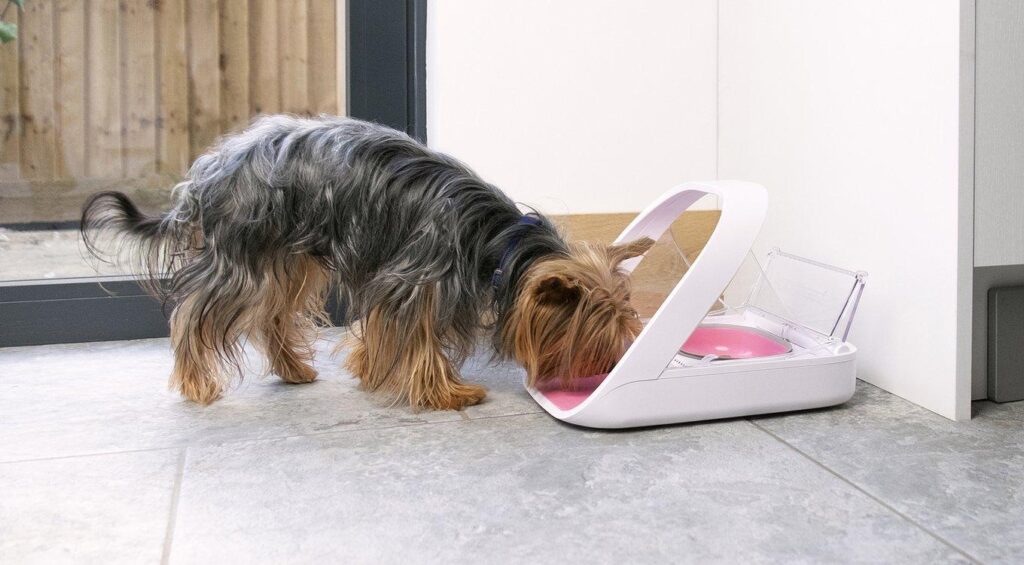
The SureFeed Microchip Pet Feeder is designed to help prevent pets from stealing each other’s food. It can recognise compatible implanted identification microchips or a SureFlap RFID collar tag, and the lid opens for a registered pet.
The manufacturer lists a 400 ml bowl capacity and support for wet and dry food. A sealed bowl helps keep food fresher between visits, and a gradual training mode allows pets to become accustomed to the moving lid.
Key features
- Recognises compatible implanted pet microchips.
- Also works with a SureFlap RFID collar tag; one tag is included.
- Supports wet and dry food.
- Stores up to 32 pet identities.
- Includes a training mode to help pets adjust to the lid.
- Uses four C-cell batteries, which are not included.
Advantages
The ability to use a compatible implanted microchip is a major convenience if your pet is already microchipped. The covered bowl can also help protect food from other household pets and reduce exposure to air and flies.
It may be useful when one pet needs exclusive access to a particular food, provided the feeder’s physical dimensions suit that animal.
Limitations
The SureFeed is a compact feeder, not a large-dog feeding station. Its opening measures approximately 21 cm wide and 15.5 cm high, and the bowl holds 400 ml. These dimensions make physical fit an essential consideration.
Although the manufacturer promotes it for multi-pet households, don’t assume that every medium or large dog can eat comfortably from it. Check your dog’s muzzle size, eating posture, and ability to approach the bowl without obstruction.
Best for: Smaller dogs or other pets that fit comfortably, particularly when implanted microchip recognition is important.
Official product information: https://www.surepetcare.com/en-eu/pet-feeder/microchip-pet-feeder
2. PETLIBRO One RFID Smart Feeder — Best for Small Dogs Needing Scheduled Dry Meals
The PETLIBRO One RFID Smart Feeder combines collar-tag recognition with scheduled dry-food dispensing. The feeder verifies its dedicated RFID tag before unlocking the food compartment, helping prevent unauthorised pets from accessing the bowl.
It also offers app-based feeding schedules and feeding logs, making it a potential option for owners who want both access control and automated meals.
Key features
- Uses a dedicated PETLIBRO RFID collar tag.
- Offers scheduled feeding and personalised meal settings.
- Provides app controls and feeding logs.
- Has a 3-litre food hopper.
- Supports dry kibble measuring approximately 2–15 mm.
- Includes battery backup for power interruptions; batteries are not included.
Advantages
Unlike a simple covered bowl, the PETLIBRO One combines selective access with automatic food dispensing. This may suit a small dog that eats dry kibble on a regular schedule and needs to be separated from another pet’s food.
App-based feeding records can also help owners review feeding activity. The backup batteries provide another layer of protection against interruptions to the mains power supply, although some connected functions are disabled when the feeder operates on batteries alone.
Limitations
The PETLIBRO One does not recognise implanted veterinary microchips or arbitrary third-party RFID tags. Your dog must wear the compatible tag supplied for the feeder.
The manufacturer describes the device as better suited to small or medium pets and says it may not work well for larger dogs. Its feeding mechanism is also designed for dry food within the specified kibble-size range.
Consider the collar tag’s fit and your dog’s comfort, especially if your dog is prone to chewing accessories or dislikes wearing a collar indoors.
Best for: Small dogs that comfortably fit the feeder, eat compatible dry kibble, and can wear the supplied RFID tag.
Official product information: https://petlibro.com/products/one-rfid-smart-feeder-for-pet
3. How to Choose the Right Feeder for Your Dog
The right product depends on your dog’s size, eating habits, food type, and the reason you need selective access. Use the following factors to narrow your options.
Check the feeder’s physical dimensions
Never assume a feeder marketed for pets will work for a dog of any size.
Check the opening height and width, bowl depth, and available space around the feeding area. Your dog should be able to approach the feeder naturally, lower its head, and eat without awkwardly twisting or squeezing into a small opening.
For medium and large dogs, a compact feeder designed primarily for cats may be impractical even if its electronic identification system works correctly.
Confirm the identification method
Ask these questions before ordering:
- Does the feeder read an implanted veterinary microchip?
- Does it require a proprietary RFID collar tag?
- Can the tag be paired with more than one feeder?
- Does it recognise one pet or support multiple registered identities?
- What happens if the tag is missing or the identification system fails?
If your dog is already microchipped and you don’t want an additional collar tag, choose a model whose manufacturer explicitly confirms implanted-microchip compatibility.
Check food type and bowl capacity
Some selective-access feeders hold food in a bowl that your pet accesses directly. Others dispense measured portions of dry kibble.
Consider whether you feed wet food, dry kibble, or a combination. Check the manufacturer’s permitted kibble dimensions, the bowl’s capacity, and how easy it is to remove and clean food-contact components.
A hopper’s capacity is not the same as the amount served in one meal. Likewise, a bowl that holds enough food for one meal may not suit a dog that eats larger portions.
Look for reliable everyday operation
An electronic feeder needs to work consistently to be useful. Review its power requirements, battery backup, cleaning instructions, and what happens during an outage or connection problem.
If the feeder uses an app, check whether its basic feeding functions continue without Wi-Fi. Don’t assume every connected feature will remain available on battery power.
Consider training and temperament
Some dogs may be wary of a moving lid, unfamiliar noises, or a collar tag. Introduce a new feeder gradually, using positive reinforcement and short, supervised sessions.
Never force a dog to put its head inside a feeder or rely on an untested device to provide exclusive access to essential food. If your dog is anxious around moving parts, a different feeding arrangement may be more appropriate.
4. Can RFID Feeders Stop Dogs From Stealing Each Other’s Food?
They can help, but they aren’t a guaranteed solution.
A selective-access feeder is designed to grant access to a recognised pet. Its effectiveness depends on the specific mechanism, the size and behaviour of the animals, and whether the device closes or restricts access reliably when the authorised pet leaves.
For example, a determined dog may push, nudge, or wait near another pet’s feeder. A small feeder may also be unsuitable if a larger dog can reach around its lid or physically interfere with it.
For the best results:
- Give each dog a clearly defined feeding station.
- Pair each compatible tag or microchip with the correct device.
- Test the setup while supervising both dogs.
- Watch for food stealing, blocking, or interference.
- Reassess the arrangement if one dog can still access the other’s meal.
If the dogs are substantially different in size, supervised meals or separate feeding areas may be more reliable than trying to use a compact selective-access bowl.
5. Managing Different Diets and Portion Requirements
Selective-access feeding can be particularly helpful when pets need different food. One dog may eat a standard adult diet while another needs a different formulation or a carefully managed feeding routine.
However, access control is not the same as portion control.
A microchip bowl may prevent another pet from eating the food, but it doesn’t necessarily measure or dispense a prescribed amount. An automatic feeder may dispense measured meals without reliably preventing another dog from stealing them.
If you need both functions, verify that the chosen model explicitly supports them. Otherwise, you may need a combination of separate feeding stations, a programmable feeder, and supervision.
For pets on a veterinary-prescribed diet, use the feeding plan provided by your veterinarian. An access-control feeder can support that plan, but it doesn’t replace the need to measure portions or monitor what each animal actually eats.
6. What If You Have a Medium or Large Dog?
For larger dogs, the most practical solution may not be a microchip feeder at all.
A standard automatic dog feeder with a suitably sized bowl and hopper can handle scheduled meals, while physical separation helps stop another dog from eating the food. This approach may be easier than trying to fit a large dog into a compact selective-access unit.
Consider these alternatives:
Separate feeding rooms: Feed the dogs in different rooms and close the doors until both have finished. This is simple and avoids compatibility concerns.
Pet gates or feeding enclosures: Use a secure barrier that allows each dog to eat without another dog reaching its bowl. Make sure the arrangement is safe and suitable for the animals.
Individual automatic feeders: Give each dog its own programmable feeder, with the stations far enough apart or separated so that one dog cannot access both bowls.
Supervised feeding: If food stealing is occasional, remaining nearby during meals may be sufficient. Remove leftover food when feeding is finished, according to your veterinarian’s guidance and food-safety needs.
These options may provide more space and flexibility than a compact microchip feeder, especially for dogs that eat large portions or need broad, stable bowls.
7. Common Mistakes to Avoid When Buying an RFID Dog Feeder
Assuming every RFID feeder reads implanted microchips
This is one of the easiest mistakes to make. Some products use a dedicated collar tag rather than a veterinary microchip. Read the manufacturer’s compatibility information before buying.
Buying a feeder that is too small
A device may recognise your dog’s tag perfectly but still be physically uncomfortable to use. Check the opening, bowl, and approach space—not just the product’s advertised pet compatibility.
Confusing scheduled feeding with selective access
A feeder that dispenses food at set times doesn’t necessarily stop another dog from eating it. If food stealing is the main issue, look specifically for a verified access-control feature.
Ignoring collar-tag comfort
A collar tag must stay attached and be recognised by the feeder. Check the tag’s attachment method, weight, durability, and suitability for your dog’s normal activities.
Expecting an electronic feeder to solve every feeding problem
Selective-access technology can reduce unwanted food sharing, but it can’t replace observation, appropriate feeding arrangements, or veterinary advice where diets and portion requirements are involved.
8. Frequently Asked Questions
Are microchip feeders suitable for dogs?
Some may work for smaller dogs, but suitability depends on the individual model. Many popular selective-access feeders are designed primarily for cats or smaller pets. Check the opening dimensions, bowl capacity, and manufacturer guidance before purchasing for a dog.
Do RFID dog feeders work with implanted microchips?
Not all of them. Some models read compatible implanted veterinary microchips, while others require a proprietary RFID collar tag. PETLIBRO One, for example, uses its dedicated collar tag and does not currently recognise implanted pet microchips according to its product information.
What is the difference between an RFID tag and a pet microchip?
An RFID collar tag is a separate identification device worn on a collar. An implanted veterinary microchip is placed under the pet’s skin and provides an identification number. A feeder must specifically support the relevant identification system to recognise the pet.
Can an RFID feeder stop one dog from eating another dog’s food?
It can help by restricting access to a recognised pet, but results depend on the design and the dogs’ behaviour. Supervise the setup, particularly if one dog is much larger, persistent, or able to interfere with the feeder.
Are RFID feeders suitable for large dogs?
Some may be too small or awkward for large dogs to use comfortably. Before buying, check the manufacturer’s dimensions and suitability guidance. Separate feeding stations or supervised meals may be more practical for larger breeds.
Can I use an RFID feeder for prescription diets?
It may help ensure that only the intended pet can access a particular food, provided the feeder suits that animal and works reliably. It does not automatically measure the correct amount, so continue following your veterinarian’s feeding instructions.
Do RFID feeders need Wi-Fi?
Not necessarily. Some selective-access feeders work locally without Wi-Fi, while app-connected models use a network for remote controls, notifications, or feeding records. Check which functions remain available if the internet or power supply fails.
Is an RFID feeder better than a regular automatic dog feeder?
Neither is universally better. An RFID feeder is useful when access control is the priority. A conventional automatic feeder may be better for larger dogs, larger portions, or scheduled meals. If you need both access control and portion dispensing, verify that the selected product offers both features.
Final Verdict: Which RFID or Microchip Dog Feeder Should You Choose?
The best choice depends on what you need the feeder to do—and whether your dog can use it comfortably.
The SureFeed Microchip Pet Feeder is worth considering for a smaller dog that fits its compact opening and needs access control through a compatible implanted microchip or SureFlap collar tag.
The PETLIBRO One RFID Smart Feeder is a potential option for small dogs that eat compatible dry kibble and can comfortably wear its dedicated collar tag. It adds scheduled dispensing and app-based feeding features, but it does not read implanted microchips and is not intended for larger dogs.
For medium and large dogs, don’t force the choice. A properly sized automatic feeder combined with separate feeding areas may be a more reliable and comfortable solution.
Ultimately, the best feeding setup matches your dog’s size, food requirements, and behaviour. Check compatibility and physical dimensions before purchasing, and supervise the initial setup to ensure every pet can eat safely and comfortably.