
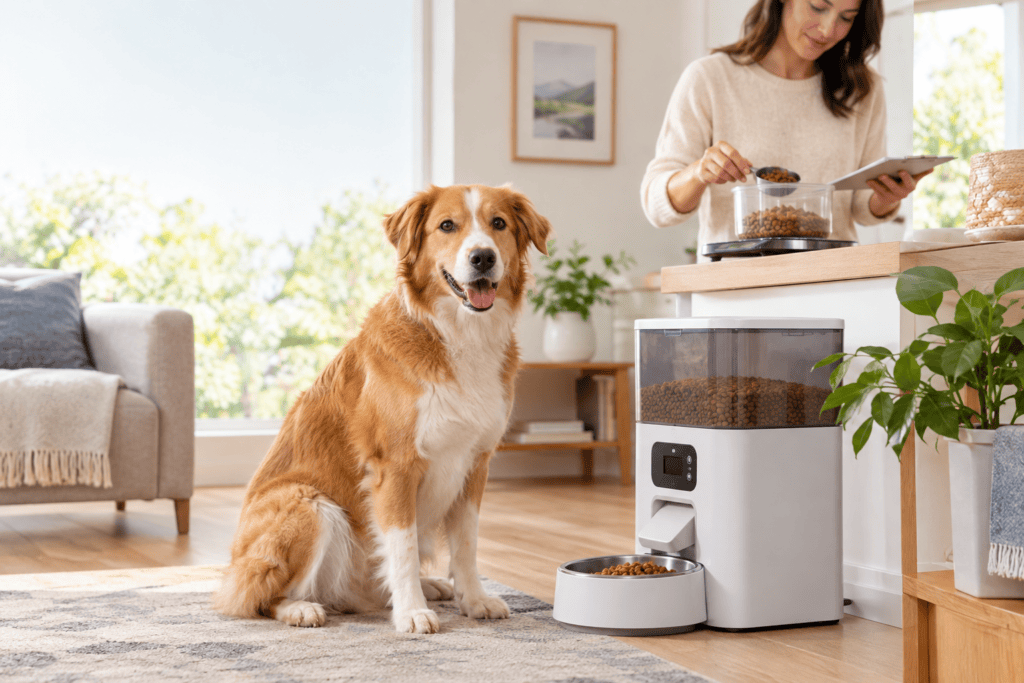
Best Automatic Dog Feeders for Prescription Diets in 2026
Compare best automatic dog feeders for prescription diets in 2026. Explore portion control, feeding schedules, selective access, and practical buying tips.
When a veterinarian prescribes a special diet for your dog, maintaining a consistent feeding routine becomes especially important. You may need to measure portions carefully, serve meals at specific times, or prevent another pet from stealing food that isn’t intended for them.
The best automatic dog feeders for prescription diets can make parts of this routine easier. Depending on the model, an automatic feeder may dispense scheduled portions of dry food, while a microchip-controlled feeder can restrict access to a registered pet. Some connected models also provide feeding records or notifications.
However, no automatic feeder is automatically suitable for every prescription diet. Many programmable models are designed for dry or semi-moist kibble, while some veterinary diets require wet food, a particular texture, or a feeding method that a machine cannot accommodate.
In this guide, we’ll compare useful feeder options, explain the difference between portion control and selective access, and help you choose a setup that supports your veterinarian’s instructions. We’ll also cover the limitations you should understand before relying on an automatic feeder.
Important: An automatic feeder is a feeding-management tool, not a medical device. Follow your veterinarian’s instructions on food type, daily quantity, meal timing, and any medication-related requirements. If you’re unsure whether a feeder is appropriate for your dog’s prescribed diet, ask your veterinary team before changing the feeding routine.
Quick Comparison: Automatic Feeders for Prescription Diets
| Feeder | Best use | Food and feeding features | Main limitation |
|---|---|---|---|
| PetSafe Healthy Pet Simply Feed | Scheduled portions of dry or semi-moist food | Up to 12 meals daily, adjustable portions, slow-feed option, 24-cup hopper | Does not identify which pet is eating |
| PetSafe Smart Feed Automatic Pet Feeder, 2nd Generation | App-managed meal scheduling | Scheduled meals, remote feeding controls, backup battery option | Not a selective-access feeder; confirm regional specifications |
| SureFeed Microchip Pet Feeder | Preventing another pet from accessing a prescribed diet | Recognises a compatible implanted microchip or RFID collar tag; supports wet and dry food | Compact, 400 ml bowl; not a conventional timed meal dispenser |
| SureFeed Microchip Pet Feeder Connect | Selective access plus feeding monitoring | Microchip access, integrated weighing, app-based feeding records | Compact bowl and additional Hub requirement for app connectivity |
These products address different needs, so they should not be treated as interchangeable. The PetSafe models focus on scheduled dispensing, whereas the SureFeed products focus on identifying the pet allowed to access the food. Manufacturer specifications support these distinctions. PetSafe Healthy Pet Simply Feed · PetSafe Smart Feed · SureFeed Microchip Pet Feeder · SureFeed Microchip Pet Feeder Connect.
1. PetSafe Healthy Pet Simply Feed — Best for Scheduled Portions

The PetSafe Healthy Pet Simply Feed is a programmable feeder designed for cats and small to medium-sized dogs. It is a useful candidate for dogs whose prescribed feeding plan involves compatible dry or semi-moist food served at set times.
According to the manufacturer, the feeder holds up to 24 cups of food and can schedule up to 12 meals per day. Individual meal portions can be set from 1/8 cup to 4 cups, and a slow-feed setting can distribute a meal over 15 minutes.
Key features
-
- Schedules up to 12 meals per day.
-
- Adjustable portions from 1/8 to 4 cups.
-
- Holds up to 24 cups of compatible food.
-
- Supports dry and semi-moist kibble up to the manufacturer’s specified size.
-
- Includes a slow-feed option for pets that eat too quickly.
-
- Uses four D-cell batteries; a wall adaptor is sold separately in the US model listing.
Advantages
Consistent meal timing: Scheduled dispensing can help maintain the feeding timetable recommended by your veterinarian.
Adjustable portions: You can set different amounts for different scheduled meals, within the feeder’s supported range.
Large hopper: The 24-cup capacity may reduce refill frequency, depending on your dog’s daily food requirement and the density of the food.
Slow-feed option: This can help spread a meal over time for dogs that eat too quickly, although it isn’t a substitute for veterinary advice about eating behaviour.
Limitations
The feeder does not recognise individual pets. If you have several animals at home, another dog may still eat from the bowl unless you manage access separately.
Its portion settings are expressed in volume, not necessarily an exact weight in grams. Different kibble shapes and densities can affect how much food a measured volume weighs. If your veterinarian has prescribed a precise gram amount, weigh the food and test the feeder’s output before relying on its settings.
The manufacturer describes this model as suitable for small to medium-sized dogs. Owners of larger dogs should check the bowl dimensions and meal capacity carefully.
Who should consider it?
This feeder is worth considering if your dog eats compatible dry or semi-moist food and needs a repeatable meal schedule. It is less appropriate if the diet requires wet food, exact weight-based portions that you cannot verify, or guaranteed protection against another pet stealing meals.
Official product page: https://www.petsafe.com/p/healthy-pet-simply-feed/PFD00-14574/
2. PetSafe Smart Feed Automatic Pet Feeder, 2nd Generation — Best for App-Based Feeding Management

The PetSafe Smart Feed Automatic Pet Feeder, 2nd Generation, adds app-based controls to scheduled food dispensing. It is designed for dogs and cats and may suit owners who want to manage meal times remotely.
The manufacturer lists scheduled feeding of up to 12 meals per day, portion settings from 1/8 cup to 4 cups per meal, and a slow-feed option. The model uses a power adaptor and offers a backup-battery option with four D-cell alkaline batteries, which are not included.
Key features
-
- App-based feeding controls.
-
- Scheduled meals and adjustable portion settings.
-
- Up to 12 scheduled meals daily.
-
- Slow-feed setting for compatible meals.
-
- Power adaptor with an optional battery backup.
-
- A removable stainless-steel bowl and holder.
Advantages
Remote management: App controls can be convenient if your schedule changes and you need to manage feeding from your phone.
Repeatable routine: Scheduled meals can help you maintain the daily timetable your veterinarian has recommended.
Backup-power option: Batteries can provide additional protection during a mains-power interruption, subject to the manufacturer’s instructions and the feeder’s operating mode.
Limitations
This is a dispensing feeder, not a microchip-controlled bowl. It does not independently prevent another dog from eating the food.
App connectivity is also not the same as proof that a meal was consumed. Check the available feeding notifications and distinguish between a meal being scheduled or dispensed and your dog actually eating it.
Confirm the exact model and regional version before purchasing, as product specifications, app availability, and power accessories may differ by market.
Who should consider it?
Choose this model if app-based scheduling is useful and your dog’s prescribed diet is compatible with the feeder’s dispensing mechanism. Plan for separate feeding arrangements if another pet could access the food.
Official product page: https://www.petsafe.com/p/smart-feed/PFD00-16828/
3. SureFeed Microchip Pet Feeder — Best for Preventing Food Sharing

If your main concern is another pet eating your dog’s prescribed food, the SureFeed Microchip Pet Feeder addresses a different problem from a conventional automatic dispenser.
It recognises a compatible implanted identification microchip or a SureFlap RFID collar tag. The lid opens for a registered pet and stays closed for unauthorised animals. The manufacturer lists a 400 ml bowl and support for wet and dry food.
Key features
-
- Recognises compatible implanted pet microchips.
-
- Also supports a compatible SureFlap RFID collar tag.
-
- Suitable for wet or dry food.
-
- Covered bowl helps keep food fresher between visits.
-
- Training mode helps pets become accustomed to the lid.
-
- Stores registered pet identities in memory.
Advantages
Selective access: It can help prevent another pet from eating food assigned to the registered animal.
Wet-food compatibility: Unlike many hopper-based automatic dispensers, the bowl can accommodate wet food as well as dry food.
No conventional dispensing schedule required: A pet can return to its bowl to eat at its own pace, provided this suits the veterinarian’s feeding plan.
Limitations
The SureFeed is primarily marketed for multi-pet households and is compact. Its bowl capacity is 400 ml, and the opening is approximately 21 cm wide by 15.5 cm high. These dimensions make physical fit particularly important for dogs.
It does not function like a conventional timed hopper feeder that dispenses a new measured meal at a scheduled hour. It controls access to food placed in the bowl.
If your dog needs larger meals, has a broad muzzle, or struggles with a covered opening, this may not be a practical choice. Test the physical fit and discuss the arrangement with your veterinarian if the prescribed diet requires a strict feeding schedule.
Who should consider it?
Consider this feeder when food theft is the main issue, and your dog can comfortably use the bowl. It is not a universal solution for medium or large dogs.
Official product page: https://www.surepetcare.com/en-us/pet-feeder/microchip-pet-feeder
4. SureFeed Microchip Pet Feeder Connect — Best for Selective Access and Feeding Records
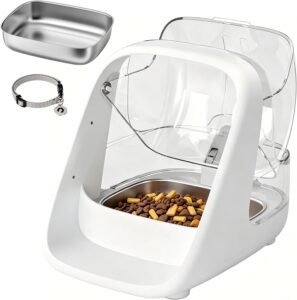
The SureFeed Microchip Pet Feeder Connect combines selective access with app-based feeding monitoring. The manufacturer lists integrated scales that help measure food portions to within 1 gram, along with feeding records and notifications.
It supports wet and dry food and has a 400 ml bowl. For app connectivity, the feeder needs a compatible Sure Petcare Hub connected to your home router; if you do not already have one, check whether a bundle is available.
Key features
-
- Access control using a compatible implanted microchip or RFID collar tag.
-
- Integrated scales to help measure food portions.
-
- App-based feeding records and notifications.
-
- Supports wet and dry food.
-
- 400 ml bowl capacity.
-
- Requires a Hub for app connectivity.
Advantages
Access control and monitoring: The device can help restrict food access to a registered pet while recording feeding activity.
Weight-based portion preparation: Integrated weighing can help you prepare a more consistent amount of food than estimating by eye.
Feeding records: The app can help you review feeding patterns and notice changes worth discussing with your veterinary team.
Limitations
The Connect model is still a compact selective-access feeder, not a large-capacity hopper that automatically dispenses multiple meals throughout the day.
Its weighing feature should not be interpreted as a guarantee that every prescribed amount is delivered and consumed exactly as intended. Follow the instructions for preparing portions and verify the amount your dog actually eats when precision is important.
The manufacturer’s Italian product page primarily describes the device for cats, including those needing careful dietary monitoring. Do not assume it suits every dog. Check the dimensions and ask the manufacturer about canine suitability if necessary.
Who should consider it?
This model may be worth investigating when your dog fits comfortably, food theft is a concern, and feeding records would help you manage a veterinarian-directed routine. Confirm the total cost, including any Hub required.
Official product page: https://www.surepetcare.com/it-it/ciotola/microchip-pet-feeder-connect
5. How to Choose a Feeder for a Prescription Diet

The best feeder depends on the actual feeding instructions, not just the name of the diet or the product’s smart features.
Check the prescribed food type
First, establish whether your dog eats dry kibble, semi-moist food, wet food, or a combination.
Hopper-based feeders usually have restrictions on food texture and kibble size. Wet food may not flow through a dispensing mechanism safely or reliably, and food that needs refrigeration or special handling may not be suitable for extended storage in a feeder.
If the prescription requires wet food, consider a suitable bowl-based access-control device or follow a manual feeding routine approved by your veterinarian.
Confirm the portion size and accuracy
If the feeding plan specifies grams per meal, don’t assume that a cup-based setting will deliver the exact weight.
Kibble density and shape affect how much food fits into a given volume. Test the feeder with the exact food your dog eats, weigh several dispensed portions, and check for consistency.
If your veterinarian has set a strict weight-based amount, ask whether the feeder’s dispensing method is appropriate. A device with integrated scales may help with measuring, but you still need to confirm how it works and what the dog actually consumes.
Match meal timing to the veterinary plan
Some dogs need several small meals, while others follow a simpler daily schedule. Choose a model that can accommodate the prescribed frequency and meal size.
Do not change meal timing, split portions differently, or leave food available all day simply because a feeder makes it convenient. Confirm any changes with your veterinarian.
Decide whether access control is necessary
A programmable feeder may dispense the right food at the right time, but it cannot identify which pet eats it unless it specifically supports selective access.
If another dog steals food, you may need a microchip feeder, separate rooms, a secure feeding area, or supervised meals. In some homes, a standard feeder and a physical barrier will be more practical than a compact microchip bowl.
Check cleaning and storage requirements
Food-contact parts should be easy to clean and dry thoroughly. Check whether bowls, hoppers, lids, and dispensing components can be removed and washed safely.
Follow the food manufacturer’s storage instructions. Do not leave wet food sitting in a feeder for longer than recommended, and avoid mixing old and fresh food in a way that compromises freshness.
6. Preventing Other Pets from Eating Prescription Food
When multiple pets share a home, food theft can undermine an otherwise careful feeding plan.
Here are practical approaches to consider:
Use separate feeding areas. Feed dogs in separate rooms or behind a secure barrier until both have finished. This can be especially useful when their food requirements differ substantially.
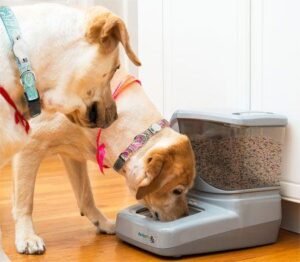
Consider selective-access feeding. A microchip feeder may help if the pet fits the device and the access-control mechanism works reliably in your household.
Supervise meals. If one dog routinely steals food, supervision may be more dependable than an untested electronic solution.
Remove leftover food when appropriate. Follow your veterinarian’s directions on meal availability and food storage. This is particularly important when wet food is involved.
Test the arrangement. Watch your dogs during the first several meals. A determined dog may nudge a feeder, wait nearby, or try to reach another bowl. Adjust the setup if food sharing continues.
A feeder should support the prescribed routine, not create a false sense of security.
7. Can Automatic Feeders Handle Wet Prescription Food?
Some feeders are designed for wet food, but many conventional automatic dispensers are intended for dry or semi-moist kibble.
A microchip-controlled bowl such as the SureFeed Microchip Pet Feeder supports wet and dry food, but it has a limited bowl capacity and does not work like a timed hopper dispenser.
Before using any feeder with wet food, check:
-
- Whether the manufacturer explicitly supports wet food.
-
- How long food may safely remain in the device.
-
- Whether the bowl and lid are easy to clean.
-
- Whether the feeding arrangement matches your veterinarian’s schedule.
-
- Whether the food needs refrigeration or other special handling.
If the food must be served freshly or at specific intervals that the device cannot manage, manual feeding may be the safer option.
8. What About Large Dogs?
Many compact selective-access feeders are designed primarily for cats or small pets. A large dog may have difficulty fitting its muzzle through the opening or eating comfortably from a small bowl.
For medium and large dogs, a programmable feeder with an appropriately sized bowl may be more practical for dry food. If another pet might steal the food, combine the feeder with a separate feeding room or secure barrier.
Before purchasing, measure your dog’s muzzle and compare the dimensions with the manufacturer’s specifications. Also consider whether the device is stable enough for a dog that might nudge it while eating.
Do not buy a feeder based solely on hopper capacity. The dog must be able to eat comfortably, and the machine must dispense the required food consistently.

9. When Manual Feeding May Be Better
Automation is useful only when the device fits the feeding plan. Manual feeding may be more appropriate when:
-
- The prescribed diet is not compatible with the feeder.
-
- The food requires special handling or refrigeration.
-
- Your veterinarian has instructed you to supervise each meal.
-
- Medication must be given with food under specific directions.
-
- The dog has difficulty using the device.
-
- The required portion accuracy cannot be verified.
-
- You need to observe how much food the dog actually consumes.
If your dog repeatedly refuses meals, vomits after eating, or develops a sudden change in appetite, contact your veterinary team rather than relying on the feeder’s records alone.
10. Frequently Asked Questions
Are automatic dog feeders suitable for prescription diets?
They can be useful when the prescribed food is compatible with the feeder and the device can support the required meal schedule and portions. Confirm the setup with your veterinarian, particularly if the diet requires exact weight-based servings or special handling.
Which automatic dog feeder is best for prescription food?
There is no single best feeder for every prescription diet. PetSafe Healthy Pet Simply Feed is worth considering for scheduled portions of compatible dry or semi-moist food. SureFeed models may help when preventing food theft is the main concern and the dog fits the bowl comfortably.
Can an automatic feeder measure prescription food accurately?
Some feeders provide portion settings, and some selective-access models include integrated scales. However, volume settings do not automatically equal a specific weight in grams. Test the feeder with your dog’s actual food and verify the dispensed amount.
Can a microchip feeder prevent another dog from eating prescription food?
It can restrict access to a registered pet, provided the product fits the dog and the mechanism works reliably. It does not automatically dispense a series of scheduled meals, so make sure the access-control design matches your feeding requirements.
Can I use an automatic feeder for wet prescription food?
Only if the specific device supports wet food and its storage and cleaning requirements are compatible with the feeding plan. Many hopper feeders are intended for dry or semi-moist kibble. Ask your veterinarian if you’re unsure.
Are smart feeders necessary for dogs on prescription diets?
No. A smart feeder can be convenient, but a conventional feeder or supervised manual feeding may be more suitable. The priority is to follow the prescribed food type, quantity, and timing—not to use the most technologically advanced device.
Should I use an automatic feeder if my dog takes medication with meals?
Ask your veterinarian first. Medication instructions vary, and some treatments require careful timing or confirmation that the full meal has been eaten. A scheduled dispenser alone may not provide the supervision needed.
What if I have two dogs on different prescription diets?
Use separate feeding areas or another reliable way to prevent food sharing. Individual feeders may help, but standard automatic feeders do not identify which dog eats from them. A selective-access feeder may be an option if the dog fits comfortably and the product is suitable for the food.

Final Verdict: Which Feeder Should You Choose?
The best automatic dog feeder for a prescription diet is the one that supports the veterinarian’s instructions and suits your dog’s size, food, and feeding behaviour.
-
- For scheduled portions of compatible dry or semi-moist food: Consider the PetSafe Healthy Pet Simply Feed.
-
- For app-based scheduling and remote meal management: Investigate the PetSafe Smart Feed Automatic Pet Feeder, 2nd Generation.
-
- For preventing food theft: Consider the SureFeed Microchip Pet Feeder if your dog fits its compact opening and the bowl suits the feeding plan.
-
- For selective access plus feeding records: Investigate the SureFeed Microchip Pet Feeder Connect, checking the Hub requirement and the dog’s physical fit.
If none of these options meets the prescribed feeding requirements, separate feeding stations and supervised manual feeding remain valid solutions.
Most importantly, verify the food type, meal amount, and timing with your veterinary team. An automatic feeder can help make a routine more consistent, but the goal is to deliver the correct diet safely—not simply to automate mealtimes.