
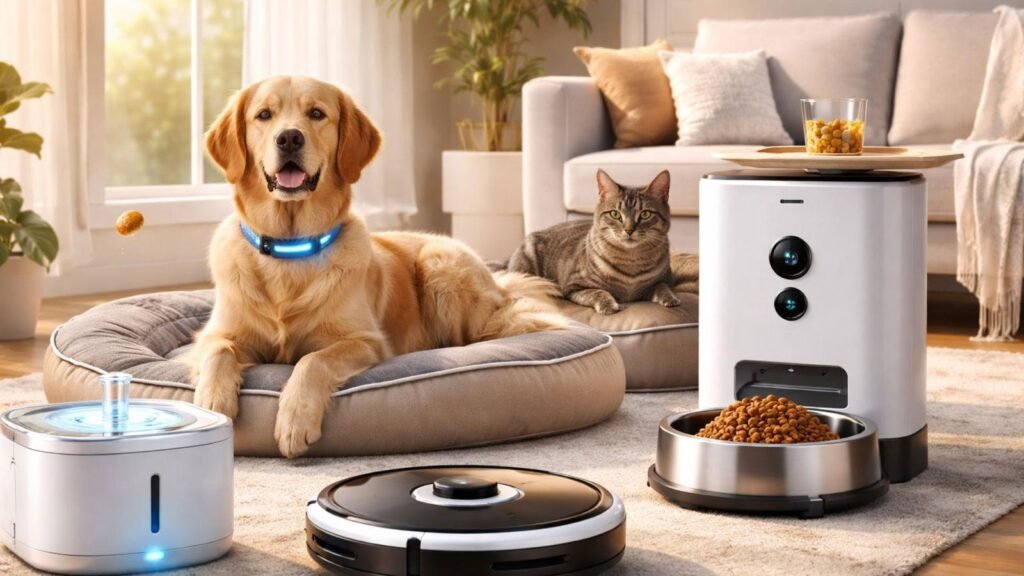
10 Smart Pet Gadgets Every Modern Pet Owner Should Know in 2027
Discover 10 smart pet gadgets for 2027, from automatic feeders and AI pet cameras to GPS trackers and innovative devices that simplify pet care.
Technology is changing the way we live, work, and interact with the world around us. Interestingly, our beloved pets are also benefiting from this technological revolution.
For modern pet owners, taking care of a dog or cat involves much more than providing food, water, shelter, and affection. Busy schedules, work commitments, and other daily responsibilities can sometimes make maintaining consistent pet care routines challenging.
Fortunately, smart technology is introducing innovative solutions that can make everyday pet ownership more convenient, organised, and informed.
From automatic pet feeders and AI-powered cameras to GPS tracking collars and robotic toys, today’s smart pet gadgets offer exciting possibilities for improving the way we care for our animal companions.
But which devices are genuinely worth considering? How do they work, and what benefits can they offer?
Whether you are a first-time pet owner or someone looking to upgrade your existing pet care setup, here are ten smart pet gadgets worth knowing about in 2027.
1. Smart Automatic Pet Feeders: Making Mealtimes Easier

Feeding pets consistently is one of the most important responsibilities of every pet owner. However, maintaining regular feeding schedules can become difficult when work, travel, or unexpected commitments interfere with daily routines.
Smart automatic pet feeders offer a practical solution.
These devices are designed to dispense predetermined amounts of food at programmed times. Depending on the model, owners can manage feeding schedules through a control panel or smartphone application.
Some advanced feeders offer additional features such as:
-
- Programmable feeding schedules.
-
- Adjustable portion sizes.
-
- Smartphone-controlled feeding.
-
- Food-level notifications.
-
- Feeding history.
-
- Built-in cameras and voice communication.
One of their biggest advantages is convenience. Owners can maintain more consistent feeding routines without manually distributing every meal.
They can also help pets that require carefully managed meal portions.
What should you consider before buying one?
Look for a feeder that accommodates your pet’s food type, provides reliable portion control, and is easy to clean. Battery backup can also be valuable during power interruptions.
Remember that automatic feeders should not be treated as substitutes for supervision. Owners must regularly check food supplies, verify that the dispensing mechanism works, and ensure that pets receive appropriate nutrition.
Best suited for: Busy pet owners, pets with scheduled feeding requirements, and households that need additional feeding convenience.
2. AI-Powered Pet Cameras: Keep an Eye on Your Pets Remotely

Have you ever wondered what your dog or cat does when you leave home?
Smart pet cameras make it easier to observe your pets remotely, providing reassurance and helping owners remain connected throughout the day.
Unlike traditional security cameras, some pet cameras are specifically designed with animal-related features.
Depending on the model, these devices may include:
-
- Live video streaming.
-
- Two-way audio communication.
-
- Night vision.
-
- Motion detection.
-
- Activity notifications.
-
- Treat dispensing.
-
- AI-assisted activity recognition.
Some systems can identify certain activities or distinguish between different types of movement. Others provide alerts when they detect unusual activity.
For example, a camera may help an owner observe whether a dog is resting comfortably, moving around frequently, or showing signs of distress.
However, AI-based behaviour recognition varies considerably between products and should not be confused with professional behavioural or medical assessment.
What should you consider before buying one?
Image quality, internet connectivity, application reliability, privacy protection, and subscription requirements are important considerations.
Choose a camera with secure account protection and features that match your household’s needs.
Best suited for: Owners who spend considerable time away from home and want additional visibility into their pets’ daily activities.
3. Self-Cleaning Litter Boxes: A Cleaner Environment for Cats

Cleaning litter boxes is an unavoidable part of responsible cat ownership.
Fortunately, self-cleaning litter boxes are helping simplify this repetitive task.
These automated devices use different mechanisms to separate waste from clean litter and collect it in a designated compartment.
Depending on their design, some models offer:
-
- Automatic cleaning cycles.
-
- Motion or weight sensors.
-
- Waste collection compartments.
-
- Smartphone notifications.
-
- Usage monitoring.
-
- Maintenance reminders.
Certain connected models can also record how frequently a cat uses the litter box.
This information may help owners notice changes in bathroom habits, which can sometimes justify closer observation or veterinary attention.
Nevertheless, these measurements are not medical diagnoses.
What should you consider before buying one?
First, consider your cat’s size, temperament, and willingness to use automated equipment.
Check the manufacturer’s safety features, cleaning requirements, waste compartment capacity, and availability of replacement components.
Introduce the device gradually and maintain access to a familiar litter box until your cat is comfortable.
Owners should also inspect waste regularly rather than depending entirely on automated cleaning.
Best suited for: Cat owners seeking greater convenience, households with multiple cats, and people interested in connected litter management.
4. Smart Pet Water Fountains: Encouraging Better Hydration

Fresh drinking water is essential for the health and well-being of dogs and cats.
Smart pet water fountains offer an alternative to traditional stationary water bowls by circulating water through a filtration system.
Many models include features such as:
-
- Continuous or sensor-activated water circulation.
-
- Replaceable filters.
-
- Water-level indicators.
-
- Low-water notifications.
-
- Quiet pumping systems.
-
- Smartphone connectivity on selected models.
Some fountains provide filtered water through activated carbon or other filtration materials designed to reduce certain impurities and odours.
Moving water may also attract some pets that show less interest in drinking from ordinary bowls.
However, not every animal prefers a fountain, and drinking preferences vary between individual pets.
What should you consider before buying one?
Look for a fountain that is easy to disassemble and clean, has an appropriate water capacity, and offers readily available replacement filters.
Consider the noise level and the availability of a backup water bowl if the device stops working.
Most importantly, regularly replace the water and clean the fountain according to the manufacturer’s instructions.
Best suited for: Cats and dogs that enjoy drinking from circulating water sources and owners who want a convenient hydration setup.
5. GPS Pet Trackers and Smart Collars: An Additional Layer of Safety

Few experiences are more frightening for a pet owner than discovering that a beloved dog or cat has gone missing.
GPS pet trackers and smart collars offer an additional way to monitor an animal’s location.
These devices are generally attached to a collar or integrated into a wearable accessory.
Depending on the product, they may provide:
-
- GPS location tracking.
-
- Location history.
-
- Virtual boundary alerts.
-
- Activity monitoring.
-
- Location notifications.
-
- Smartphone-based tracking.
Some trackers use cellular networks, while others rely on Bluetooth, radio frequency, or nearby compatible devices.
These differences are important because tracking range, coverage, and performance can vary significantly.
A GPS tracker can be particularly helpful for dogs that accompany their owners outdoors or cats that are permitted to explore outside.
What should you consider before buying one?
Check location accuracy, battery life, network coverage, device weight, water resistance, and subscription costs.
Make sure the tracker is appropriate for your pet’s size and that the collar attachment is secure.
Remember that a GPS tracker is not a substitute for identification tags, microchipping, secure fencing, or responsible supervision.
Best suited for: Owners of adventurous dogs, outdoor cats, and pets that may be at greater risk of wandering away.
6. Interactive Robotic Pet Toys: Making Playtime More Interesting
Play is an essential part of a pet’s physical and mental well-being.
Cats need opportunities to express natural hunting behaviours, while dogs benefit from activities that encourage movement, exploration, and problem-solving.
Interactive robotic toys introduce automation into playtime.
These gadgets may include:
-
- Motion-activated toys.
-
- Automated moving balls.
-
- Programmable play devices.
-
- Interactive laser toys for cats.
-
- Treat-dispensing puzzles.
-
- Robotic toys that respond to movement.
Some devices can be controlled through smartphone applications, while others operate automatically according to programmed routines.
For indoor cats, interactive toys may provide additional stimulation when their owners are occupied.
For dogs, automated toys can offer alternative forms of play and enrichment.
However, automated toys should complement rather than replace interactive play with owners.
What should you consider before buying one?
Choose toys according to your pet’s age, size, temperament, and play style.
Inspect materials, moving components, batteries, and small detachable parts for potential hazards.
Some toys require supervision, especially when pets are enthusiastic chewers.
For cats, laser-based toys should be used thoughtfully, with opportunities to catch a physical toy or receive a reward at the end of play.
Best suited for: Indoor cats, energetic dogs, and pets that benefit from additional environmental enrichment.
7. Smart Pet Health and Activity Monitors: Understanding Daily Habits

What if you could better understand how much your pet moves, rests, and sleeps throughout the day?
Pet activity monitors and wearable health-related devices are designed to provide information about these everyday patterns.
Usually attached to a collar or harness, these devices may collect information through movement sensors and other monitoring technologies.
Depending on the product, features can include:
-
- Daily activity tracking.
-
- Rest and sleep pattern monitoring.
-
- Exercise summaries.
-
- Activity comparisons over time.
-
- Behavioural pattern notifications.
-
- Wellness-related reports.
Some systems allow owners to view historical information through smartphone applications.
For example, if a normally energetic dog becomes noticeably less active, an owner may recognise the change and decide to investigate further.
Similarly, monitoring daily activity patterns may help owners better understand whether their pets are receiving appropriate opportunities for movement and rest.
However, activity monitors should not be mistaken for diagnostic medical devices. Their measurements and interpretations vary, and unusual readings should be discussed with a veterinarian when appropriate.
What should you consider before buying one?
Check the device’s accuracy claims, comfort, weight, battery life, data-sharing practices, and compatibility with your smartphone.
Ensure that the device does not interfere with your pet’s normal movement or comfort.
Best suited for: Owners interested in monitoring daily activity, senior pets that need closer observation, and animals following veterinarian-recommended exercise routines.
8. Automatic Ball Launchers: Exercise and Entertainment for Dogs

Dogs generally benefit from regular physical activity, and many enjoy chasing and retrieving balls.
Automatic ball launchers bring an additional level of convenience to this familiar activity.
These devices are designed to launch appropriately sized balls over adjustable distances, encouraging dogs to retrieve them.
Some models provide:
-
- Adjustable launching distances.
-
- Automatic ball launching.
-
- Rechargeable or battery-powered operation.
-
- Multiple ball storage.
-
- Training modes.
-
- Safety sensors.
Certain launchers can be used indoors, while others are designed for outdoor environments.
They can provide additional opportunities for physical activity, particularly for dogs that enjoy repetitive fetching games.
However, not every dog is comfortable with mechanical toys, and repetitive high-intensity fetching may not be appropriate for every animal.
What should you consider before buying one?
Look for a model that accommodates your dog’s size, uses appropriately sized balls, and provides reliable safety features.
Start with short distances and supervise initial sessions so your dog can become familiar with the equipment.
Always consider your dog’s physical condition and seek veterinary advice if you have concerns about exercise intensity.
Best suited for: Dogs that enjoy retrieving games and owners looking for additional interactive exercise equipment.
9. Smart Pet Doors: Convenient and Controlled Access

Traditional pet doors allow animals to move between indoor and outdoor spaces without requiring owners to open the door every time.
Smart pet doors take this concept further by introducing electronic access controls.
Depending on the model, these devices may use:
-
- Microchip identification.
-
- RFID collar tags.
-
- Electronic locking mechanisms.
-
- Programmable access schedules.
-
- Smartphone-based controls.
-
- Entry and exit notifications.
Some models are designed to recognise an authorised pet and prevent unfamiliar animals from entering the home.
This can be particularly useful for households with multiple animals or properties where controlling outdoor access is important.
Certain systems also allow owners to establish schedules that restrict access during specific hours.
What should you consider before buying one?
Check compatibility with your pet’s existing microchip or identification tag.
Consider installation requirements, door dimensions, weather resistance, battery life, and emergency access arrangements.
Also evaluate whether your home environment is suitable for independent outdoor access.
Remember that electronic access control does not eliminate the need for supervision or a safe outdoor environment.
Best suited for: Suitable households with cats or dogs that have controlled access to secure outdoor spaces.
10. Smart Environmental Monitoring Devices: Creating a Comfortable Pet-Friendly Home.

A comfortable home environment is an important part of responsible pet ownership.
Temperature, humidity, and air quality can influence the comfort of animals, particularly during extreme weather conditions.
Smart environmental monitoring devices can help owners keep track of certain household conditions.
Depending on the system, these devices may monitor:
-
- Indoor temperature.
-
- Relative humidity.
-
- Air quality indicators.
-
- Environmental changes.
-
- Temperature alerts.
-
- Connectivity with compatible smart home systems.
Some systems can send notifications when measured conditions move outside user-defined thresholds.
For example, a temperature sensor may alert an owner when a room becomes unusually warm.
These notifications can provide useful additional awareness, especially when owners are away.
However, environmental sensors do not automatically make a home safe. Owners must still take appropriate action when conditions become unsuitable.
For pets vulnerable to heat or cold, never rely exclusively on a connected monitoring device.
What should you consider before buying one?
Look for reliable sensors, clear notifications, dependable connectivity, and compatibility with your existing smart home equipment.
Consider placing sensors in locations that reflect the actual environment your pet occupies.
Best suited for: Pet owners who want to monitor indoor conditions and create a more comfortable living environment.
How to Choose the Right Smart Pet Gadgets for Your Home
With so many innovative devices available, choosing the right technology can become confusing.
The best approach is to identify your pet’s actual needs before making a purchase.
Here are six important considerations.
1. Understand Your Pet’s Individual Needs
A gadget that works well for one animal may be unsuitable for another.
Consider your pet’s age, size, temperament, health, activity level, and daily routine.
For example, a GPS tracker may be particularly useful for an outdoor cat, while a programmable feeder may be more relevant to a dog that follows a carefully managed feeding schedule.
2. Prioritise Safety and Reliability
Technology should improve pet care without introducing unnecessary risks.
Check safety mechanisms, construction quality, electrical protection, moving components, and manufacturer recommendations.
For essential equipment, consider what happens during a power failure or internet interruption.
3. Consider Ease of Use
A sophisticated gadget is not necessarily a practical one.
Choose devices with straightforward controls, reliable applications, clear instructions, and convenient maintenance requirements.
4. Check Compatibility
Before purchasing connected equipment, verify compatibility with your smartphone, home network, operating system, and existing smart home devices.
Some products also require specific subscriptions to unlock certain functions.
5. Evaluate Long-Term Costs
The purchase price is only one part of the total cost.
Consider replacement filters, batteries, accessories, subscription charges, maintenance, and potential repairs.
A less expensive device may become costly if it requires frequent replacement components.
6. Never Allow Automation to Replace Human Care
This is perhaps the most important consideration.
Automatic feeders, pet cameras, robotic toys, and monitoring systems can support daily routines, but pets still require human companionship, attention, exercise, supervision, and affection.
Smart technology should complement responsible pet ownership, not replace it.
Are Smart Pet Gadgets Worth the Investment in 2027?
For many households, smart pet gadgets can provide genuine convenience and useful additional information.
However, their value depends on how well they address individual needs.
An automatic feeder may be worthwhile for an owner who struggles to maintain consistent feeding schedules.
A GPS tracker may provide additional reassurance for someone with an adventurous outdoor cat.
A smart camera may help an owner remain connected with a dog while working away from home.
On the other hand, purchasing several expensive gadgets simply because they are technologically advanced may not provide meaningful benefits.
The smartest approach is to start with one or two devices that solve genuine problems.
Evaluate their performance, reliability, and suitability before expanding your smart pet care setup.
The Future of Smart Pet Gadgets: What’s Next?
The development of smart pet technology is far from over.
Artificial intelligence, connected sensors, wearable devices, and increasingly sophisticated automation systems are creating new opportunities for innovation.
In the coming years, we may see further developments in:
More intelligent pet monitoring: AI systems may become increasingly capable of identifying changes in movement, activity, and everyday behavioural patterns.
Integrated smart pet ecosystems: Different devices may communicate more effectively, allowing owners to manage several aspects of pet care through unified applications.
More personalised feeding systems: Connected feeders may offer improved integration with individualised feeding plans and nutritional recommendations.
Advanced wearable technology: Future pet wearables may provide more useful and reliable information about activity and selected wellness indicators.
Smarter home environments: Greater integration between pet devices and smart home systems may make environmental monitoring and routine management more convenient.
These developments are promising, but their real-world value will depend on reliability, affordability, privacy, scientific validation, and animal welfare.
Conclusion: Smarter Gadgets, Happier Pets, and More Responsible Ownership
Smart pet technology is opening exciting possibilities for modern pet owners.
From automatic feeding systems and intelligent cameras to GPS trackers, robotic toys, and environmental monitoring devices, these innovations can make everyday pet care more convenient and organised.
They can also help owners become more aware of their animals’ routines and identify changes that deserve attention.
However, technology alone cannot create a happy and healthy pet.
Love, companionship, proper nutrition, exercise, veterinary care, and responsible supervision remain fundamental to animal welfare.
The real value of automated pet care lies in using technology thoughtfully to support these responsibilities.
At AUTOMATED PET CARE, we believe the future belongs to innovations that make pet ownership smarter without making it less personal.
After all, our pets do not need a technologically perfect home. They need a loving home where technology helps us care for them better.
Smarter Technology. Happier Pets. Better Care.
Frequently Asked Questions (FAQs)
1. What are the best smart pet gadgets for modern pet owners?
Popular categories include automatic pet feeders, smart pet cameras, GPS trackers, self-cleaning litter boxes, smart water fountains, and interactive robotic toys. The best choice depends on your pet’s individual needs.
2. Are smart pet gadgets safe for dogs and cats?
Most well-designed pet devices can be used safely when selected appropriately and operated according to manufacturer instructions. Owners should check safety features, supervise unfamiliar equipment, and inspect devices regularly.
3. Can automatic pet feeders replace traditional feeding?
Automatic feeders can help maintain scheduled meals and portion sizes, but they do not replace human supervision. Owners must monitor food supplies, verify proper operation, and ensure that their pets receive appropriate nutrition.
4. Do AI-powered pet cameras really understand animal behaviour?
Some AI-powered cameras can recognise selected movements or activities and provide notifications. However, their capabilities vary, and they should not be relied upon to diagnose behavioural or medical conditions.
5. Are GPS pet trackers worth buying?
GPS trackers can be valuable for owners who want additional location awareness, especially for pets that spend time outdoors. Their usefulness depends on coverage, battery life, accuracy, and the animal’s individual circumstances.
6. Can smart gadgets help monitor pet health?
Some wearable devices and connected systems can record activity, rest patterns, and other wellness-related information. They may help owners notice changes, but they cannot replace veterinary examinations or professional diagnosis.
7. How much should I spend on smart pet technology?
There is no universal budget. Start with a device that solves a genuine problem, compare long-term costs, and consider maintenance and subscription requirements before purchasing.
8. Will smart pet gadgets replace traditional pet care?
No. Automation can simplify certain tasks, but companionship, exercise, affection, supervision, proper nutrition, and veterinary care remain essential.
A final reminder: The best smart pet gadget is not necessarily the most expensive or technologically advanced one. It is the one that genuinely improves your pet’s daily life.